Secure checkout. FREE delivery in Ireland.
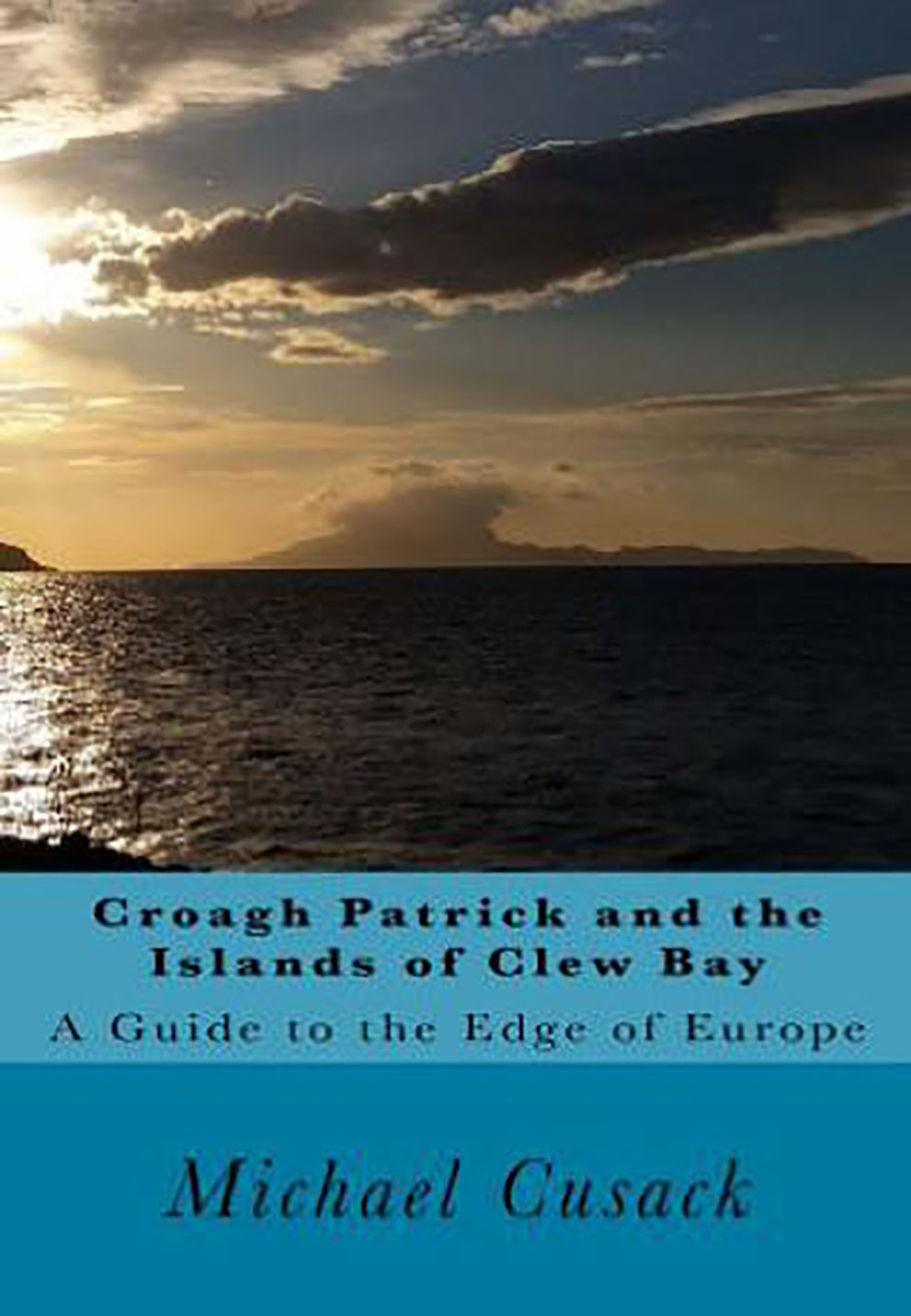
“A treasure of a publication.”
– The Mayo News
“Informed by lifelong footfall and curiosity.”
– The Irish Times
“The first time that every island in Clew Bay has been explored for the armchair traveller.”
— The Connaught Telegraph
- Island communities and family histories
- Shipwrecks and maritime stories
- Folklore, archaeology and local legends
- Maps and historical detail
- 142 islands detailed
- 23 full colour plates
‘Almost all the islands are uninhabited now, but we who are left will remember other days and other ways, the left-over echoes of people who came and went and left something of themselves behind. We’ll remember other music makers. Maybe we’ll hear the lilt of an islander’s voice on the wind. We won’t forget those we knew in the buried past.’
From the Foreword by Gerardine Cusack
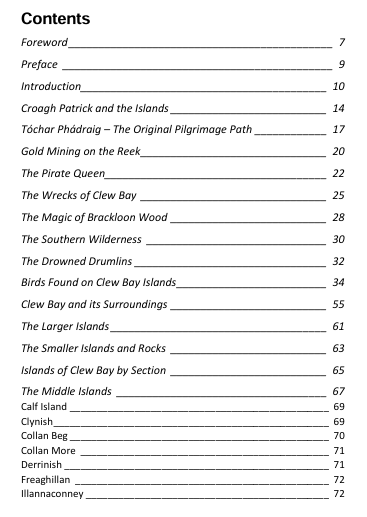
…including descriptions and facts about 142 islands, plus stories, maps, photographs and charts.
What the press says:
Michael Viney in the Irish Times
“For that amazing view of the drumlin swarm of Clew Bay, he offers not only a name for every island but often a human history of occupancy stretching back before the Famine.”
“Part social history of the bay’s myriad islands, part historical record, part geographic research, with the additional bonus of stunning photographs of the islands and the Reek.”
Mayo News Book Review
For anyone interested in the islands of Clew Bay, a recent book by Westport-born adventurer and world traveller, Michael Cusack, is an enthralling and highly readable work of research.
‘Croagh Patrick and the Islands of Clew Bay’ is a treasure of a publication – part social history of the bay’s myriad islands, part historical record, part geographic research, with the additional bonus of up to 20 pages of stunning photographs of the islands and the Reek.
Michael Cusack’s book is a labour of love, but it could hardly be otherwise. Clew Bay is in his genes. His maternal forebears have been associated with the bay, its islands and its families for well over 100 years. His great grandfather had been Admiralty Pilot, residing in Rosbeg, and was fondly remembered in island lore for his compassion in taking bags of meal to the occupied inshore islands during the famine.
His grandfather, Peter Hopkins, was one of the last Clew Bay pilots, and was as familiar with every square metre of the bay and its islands as he was with his own front garden.
Legend has it that there are 365 islands in Clew Bay, one for every day of the year. Whether this claim stands up to the test of reality is something which Michael Cusack skirts around with some diplomacy.
He lists and names 142 islands, large and small, which have been identified for ordnance survey purposes, but notes that there are many unnamed islands and rocks which remain unlisted. And, in addition, there are dozens of ‘drowned’ drumlins lying just beneath the waters of the bay.
‘Whether these make up the fabled number is a matter for argument among those better informed,’ he wisely comments.
Subheaded ‘A Guide to the Edge of Europe’, Michael Cusack’s book is a treasury of information about every one of the islands, the topography of each, its relative size, and the many legends attaching to each. There is a fascinating table of island population for each census year, revealing that in 1841, there were 35 inhabited islands with a population of 1532, while in 2011, only six islands remained inhabited, with a population of 25.
Those who regularly walk Bertra beach might be interested to know that the uninhabited island of Inishdaugh, which lies off the tip of Bertra, across a narrow but treacherous channel, is said to be the richest island in the bay. Local lore has it that the Danes buried a hoard of gold on the island, and that every seven years, a cave appears to provide access to the treasure.
There are chapters in the book dedicated to the Tochar Padraig, to Grace O’Malley and to the wrecks of Clew Bay – among them the 26 tonne Cutter, ‘Spirit’, owned by the author’s granduncle, which broke her back off Carrowmore Point in 1886, overloaded with a cargo of herring. And there is an account of the Reek gold mining controversy of 1989, a story of which a new generation needs to be reminded.
But above all else, the book is a tribute to the long association of the Hopkins family with the islands and the islanders of Clew Bay.
In a touching foreword to the book, Michael’s mother Gerardine, herself an author in her own right, says: ‘Almost all the islands are uninhabited now, but we who are left will remember other days and other ways, the left-over echoes of people who came and went and left something of themselves behind. We’ll remember other music makers. Maybe we’ll hear the lilt of an islander’s voice on the wind. We won’t forget those we knew in the buried past.’
Secure Checkout. FREE delivery within the Republic of Ireland.